What is Redis? Understanding Sentinel, Cluster, Hash Slots, and Redis Architecture
Master Redis architecture. From RDB/AOF persistence to Sentinel failover, and deep dive into Redis Cluster's 16,384 Hash Slots, Resharding, and Gossip Protocol.
The Problem: Why is Your Application Slowing Down?
As your application grows, your primary database (like PostgreSQL or MySQL) starts to struggle. Every time a user requests data, the system has to search through millions of rows on a physical disk. This creates a bottleneck. Have you ever wondered why your dashboard takes seconds to load or why your API starts failing under heavy traffic? The problem is 'Disk I/O' and the solution requires a faster layer.
The Solution: Redis
This is where Redis comes into play. Redis acts as a high-speed lane for your data. Instead of waiting for slow disk operations, Redis stores data in the system's RAM, allowing you to serve requests in sub-milliseconds. It's not just a database; it's a performance powerhouse.
What is Redis?
Redis (Remote Dictionary Server) is an open-source, in-memory data structure store. It is used as a database, cache, message broker, and streaming engine. Unlike traditional databases that store data on disk, Redis keeps everything in memory, which is why it is incredibly fast.
Key Benefits of Redis:
Cache: Stores frequently accessed data in memory to reduce database load and speed up response times.
Rate Limiting: Prevents API abuse by counting and limiting the number of requests from a specific user or IP.
Queue (Message Broker): Manages background tasks effectively using lists or Pub/Sub mechanisms.
Session Management: Keeps user session data (like login info) persistent and extremely fast to access.
Real-time Analytics: Perfect for counting page views, likes, or active users in real-time with atomic increments.
Redis Basic Logic (System Flow)
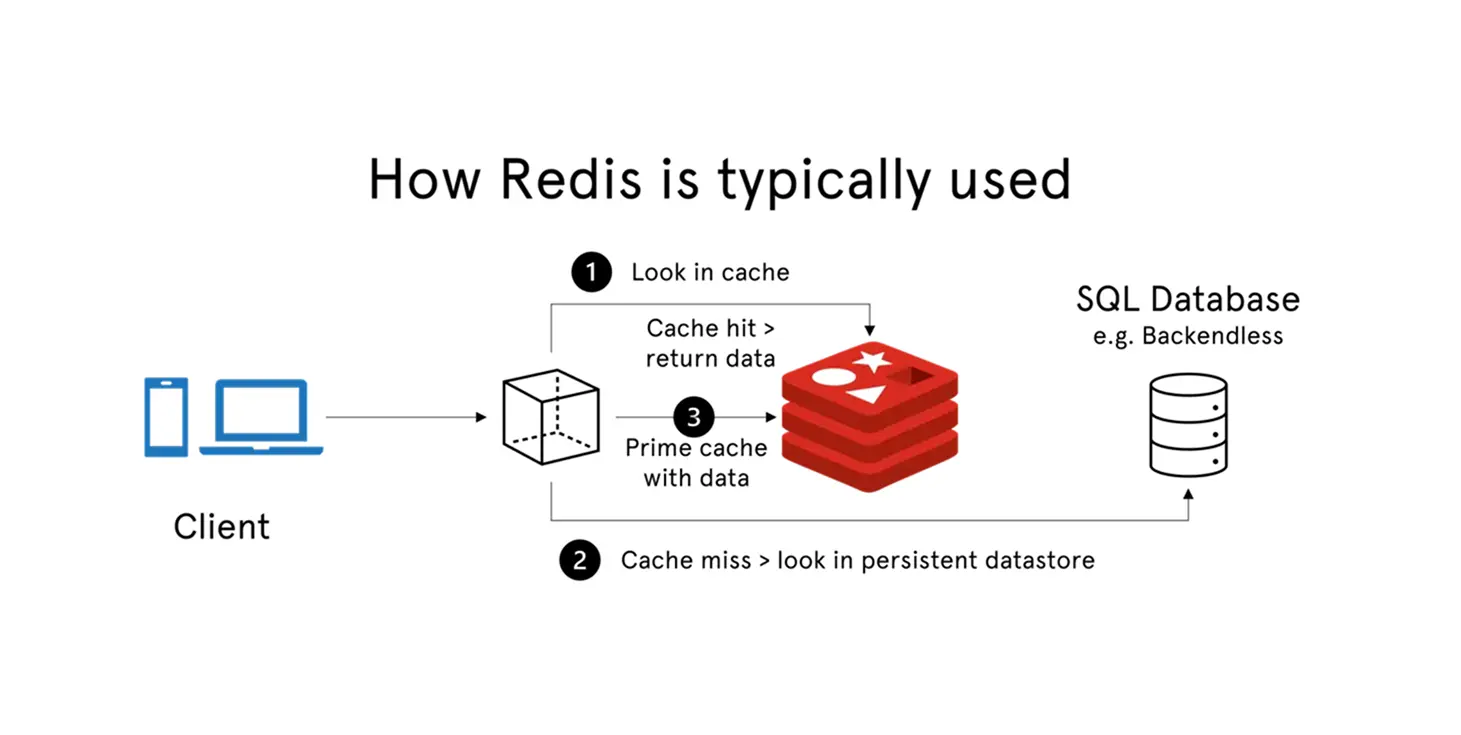
The most important feature of Redis is its In-Memory nature. While a standard DB works as 'Application → Disk', the Redis flow works as 'Application → RAM'.
The Volatility Problem: Since RAM is volatile, if the server shuts down or crashes, all data stored in memory is lost instantly. To prevent this, Redis offers Persistence mechanisms to save data to the disk.
Redis Persistence (Saving Data to Disk)
Redis provides two primary methods to ensure your data survives a restart: RDB and AOF.
1. RDB (Redis Database Snapshot)
The logic behind RDB is taking a 'photograph' of your data at specific intervals. It captures the entire state of the RAM and writes it to a compact file on the disk.
Flow: Redis Memory → Snapshot Process →
dump.rdbfile
Example Timeline:
10:00 → Snapshot taken
10:05 → Snapshot taken
10:10 → Snapshot taken
The Risk: If the 10:05 snapshot completes and the server crashes at 10:06, all data between 10:05 and 10:06 is permanently lost because it wasn't captured in a snapshot yet.
Advantages: Very small disk footprint, lightning-fast restoration during startup, and minimal CPU usage.
Disadvantages: Significant risk of data loss between snapshots.
2. AOF (Append Only File)
Instead of taking snapshots, AOF keeps a continuous log. Every single 'write' command sent to Redis is appended to a log file in real-time.
// Example Commands Logged:
SET user:1 "Ali"
INCR views
LPUSH messages "hello"
When the server restarts, Redis simply 'replays' this diary of commands to rebuild the memory state from scratch.
Flow: Redis Restart → Read AOF File → Re-run Commands → Memory Rebuilt
Advantages: Maximum durability with almost zero data loss.
Disadvantages: The log file can become very large over time, and restoring data is slower compared to RDB since every command must be re-executed.
Comparison: RDB vs AOF
Choosing the right persistence method depends on your needs. Here is a quick comparison table:
Feature | RDB | AOF |
|---|---|---|
Method | Snapshot | Command Log |
Performance | Very Fast | Slightly Slower |
Data Loss | Possible | Minimal |
Restore Speed | Fast | Slower |
Best Practice for Production: In most real-world scenarios, developers use RDB and AOF together. RDB handles fast backups and disaster recovery, while AOF ensures data safety and durability.
Redis Sentinel: The Failover Manager
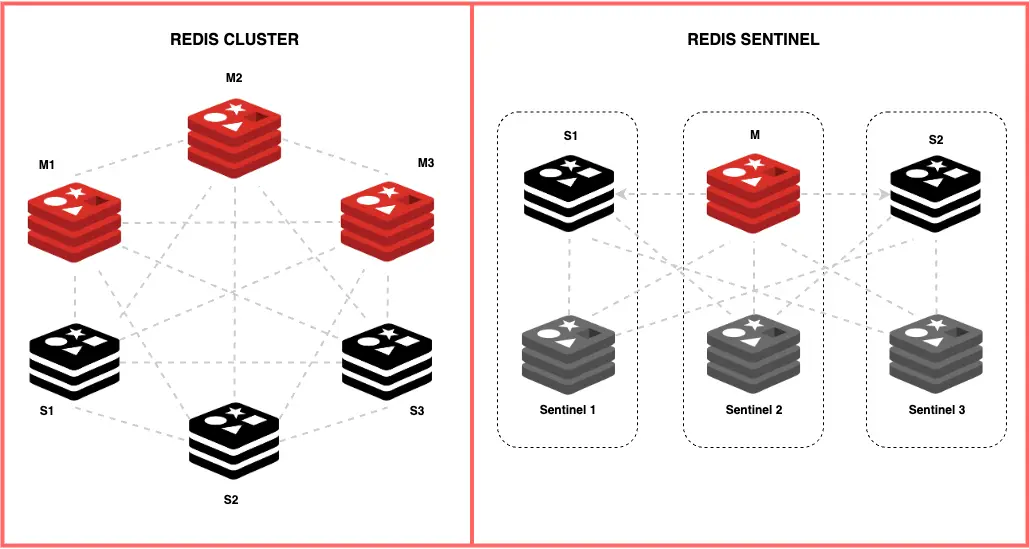
High availability is crucial for modern apps. If you only have one Redis instance (Primary) and it crashes, your entire system goes down. This is where Redis Sentinel acts as a guardian for your cluster.
The Goal: To monitor your Redis instances and automatically handle the recovery process (failover) if something goes wrong.
How Sentinel Works (The Flow)
Sentinel nodes constantly monitor the Primary node. If the Primary becomes unresponsive, the following automated flow begins:
Detection: A Sentinel node notices the Primary is down.
Quorum Decision: Sentinels talk to each other. If a majority (the Quorum) agrees that the Primary is indeed dead, the failover process starts.
Promotion: Sentinel picks one of the healthy Replica nodes and 'promotes' it to be the New Primary.
Reconfiguration: The remaining replicas are told to follow the new Primary, and the Client (your app) is notified of the new address.
Core Tasks of Sentinel:
1. Monitoring: Continuously checking if your Primary and Replica instances are working as expected.
2. Automatic Failover: If the Primary fails, Sentinel promotes a Replica to Primary without human intervention.
3. Service Discovery: Sentinel acts as a source of truth for your application. Your app asks Sentinel: "Who is the current Primary?" and Sentinel provides the correct IP address.
Redis Cluster: Scaling to Infinity
When one server's RAM isn't enough (e.g., you have 1TB of data), we use Redis Cluster. This allows you to split your data across multiple servers (Nodes).
1. The Magic of Hash Slots
How does Redis know which server has which data? It uses 16,384 Hash Slots. Think of these as numbered drawers in a giant filing cabinet. Every key you save is assigned to one of these drawers using a simple math formula:
Formula:
hash(key) % 16384
Example: If you save user:1, Redis calculates its hash, and if the result is 9000, it goes to whichever server is responsible for slot 9000 (e.g., Node 2).
2. Resharding (Adding New Nodes)
When your cluster grows, you can add Node 4. Redis then performs Resharding, which means it re-distributes the slots. Instead of 3 servers sharing the 16,384 slots, now 4 servers share them. This is true Horizontal Scaling.
3. Gossip Protocol: The Social Network of Nodes
Nodes in a cluster are constantly 'talking' to each other. This is called the Gossip Protocol. They ask each other: "Are you alive? Is Node 3 still responding?"
Health Checks: If the majority of nodes agree that Node 1 is down, they automatically trigger a failover.
Self-Healing: A Replica is promoted to Primary instantly, ensuring the cluster stays online.
Redis Data Types: When to Use Which?
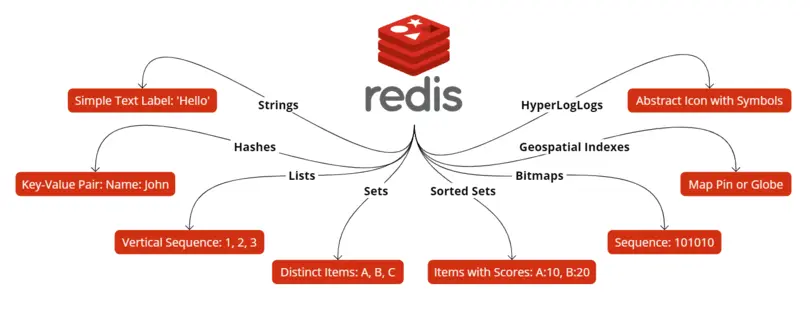
Redis is not just a simple key–value store. Here are the flexible data structures it provides:
Strings: The most basic type. Stores text, numbers, or binary data. Ideal for counters.
Hashes: Consist of field–value pairs. Perfect for storing objects such as user profiles.
Lists: Ordered collections of strings. Commonly used for queue systems.
Sets: Unordered collections of unique elements. Useful for tracking unique visitors or tagging.
Sorted Sets (ZSets): Each element has a score. Provides automatic ranking, ideal for leaderboards.
Bitmaps: Allows bit-level operations. Enables tracking daily user activity with very low memory usage.
HyperLogLog: Used to estimate the number of unique elements in very large datasets.
Summary and Conclusion
Redis is much more than a simple caching solution. With its millisecond-level speed, the reliability provided by Persistence options, high availability through Sentinel, and near-infinite scalability with Cluster, Redis sits at the heart of modern architectures. Whether you're managing a real-time game leaderboard or limiting API traffic, Redis can eliminate performance bottlenecks when used with the right data type and architecture. Understanding the core concepts in this guide will help you build faster and more resilient applications.

Comments
No comments yet be the first to say something.
Leave a comment too